


ZoomInfo is best for US enterprise outbound, Cognism for EMEA compliance, Apollo.io for SMB outbound, HubSpot Breeze Intelligence for CRM enrichment, UpLead for affordability, Lead411 for simple prospecting, and Olostep for dynamic real-time web data extraction.
What is a B2B data provider?
A B2B data provider is a platform that supplies verified contact information, firmographics, and intent signals to revenue teams. These tools enable sales, RevOps, and marketing departments to discover ideal prospects, verify email addresses, enrich CRM records, and generate outbound pipeline efficiently.
Choosing the best B2B data providers depends entirely on your specific sales motion. ZoomInfo dominates US enterprise outbound, Cognism leads in EMEA compliance, and Apollo.io offers the strongest all-in-one SMB platform. However, for teams tired of static databases, dynamic web extraction infrastructure like Olostep is replacing legacy lists entirely.
Bad data destroys pipeline. When 22.5% to 70.3% of B2B contact records decay annually, relying on stale lists means sales reps spend hours fixing CRM errors instead of closing deals. You need a system that delivers highly accurate, usable contact information exactly when your go-to-market (GTM) team needs it.
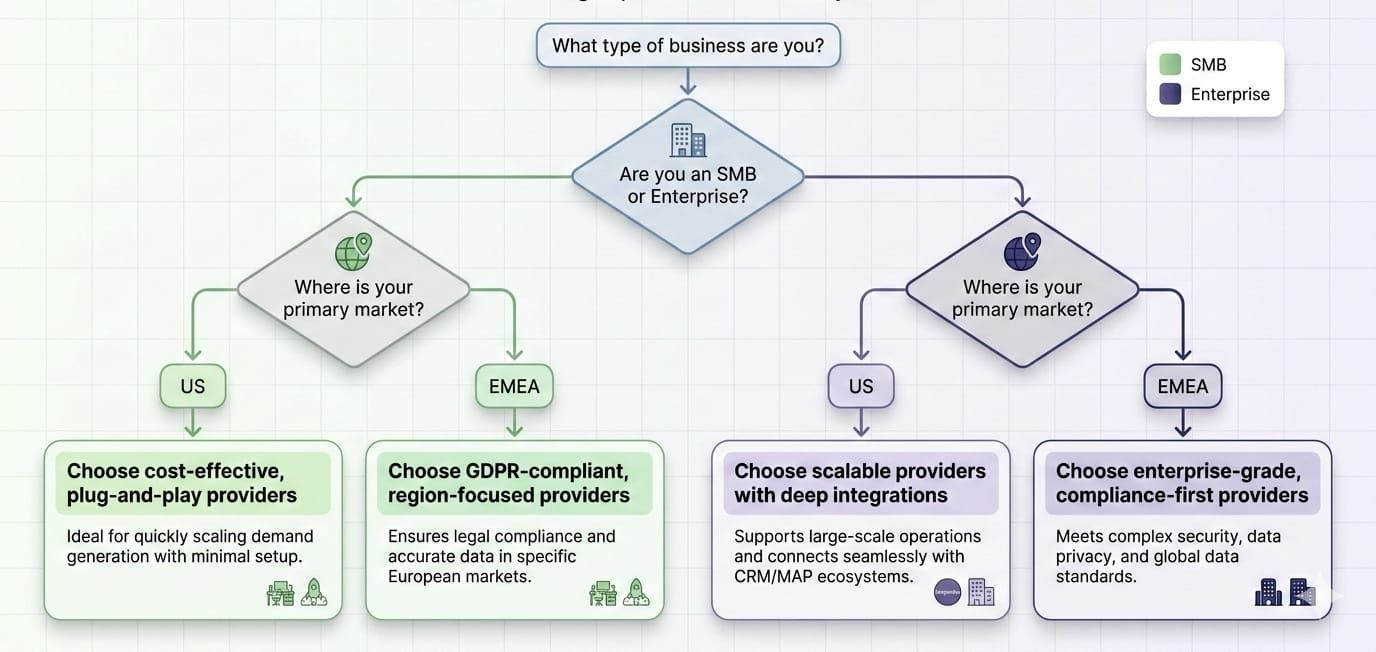
Top B2B Data Providers by Use Case
Key Takeaways:
- Match the tool to the job: A prospecting database cannot solve a CRM routing problem.
- Identify the bottleneck: Solve for net-new discovery, data decay, or workflow automation.
- Scale dictates structure: Solo founders need all-in-one tools; enterprise teams require layered data architectures.
| Use Case | Provider | Core Function | Why it Wins | Main Limitation | Best Fit |
|---|---|---|---|---|---|
| Enterprise US | ZoomInfo | Deep US contact discovery & org charts | Unmatched US coverage and Salesforce depth | Expensive, rigid contracts | Large US revenue teams |
| Enterprise EMEA | Cognism | Global contact discovery with GDPR focus | High phone connect rates in Europe | Higher platform complexity | EMEA/Global enterprise |
| SMB Outbound | Apollo.io | Database combined with sequencing | Low entry cost with built-in execution | Verification required before sending | Fast-moving SMBs |
| CRM Enrichment | HubSpot Breeze Intelligence | Enriches inbound leads and cleans CRM | Native routing and HubSpot integration | Weak as a standalone prospector | HubSpot/RevOps teams |
| Account Intelligence | Demandbase | ABM orchestration and intent signals | Prioritizes accounts showing buying signals | Does not replace contact discovery | ABM / Marketing teams |
| Verified US Phones | SalesIntel | Human-verified direct dials | High phone connect rates in the US | Narrower breadth than full suites | Phone-heavy US SDRs |
| Affordability | UpLead | Low-cost list building | Simple credit economics without lock-in | Limited enterprise depth | Small teams |
| Simple Prospecting | Lead411 | Practical outbound targeting with outbound and enrichment API. Covers US, Canada, and UK. | Easy onboarding, lower budget fit, and 96% verified email accuracy guarantee | Smaller total database | Bootstrapped teams, SMBs and startups needing US/Canada/UK coverage |
| Ad Hoc Lookups | RocketReach | Fast contact retrieval | Extremely fast solo workflows | Lacks workflow automation | Solo reps / recruiters |
| LinkedIn Speed | Lusha | Browser-extension prospecting | High rep adoption on social profiles | Credit economics scale poorly | Rep-led prospecting |
| Dynamic Pipeline | Olostep | Real-time web data extraction & parsing | Pulls live JSON data without database limits | Requires initial workflow setup | RevOps / Data Engineers |
Note: These tools solve fundamentally different problems. Some act as databases, some as enrichment engines, some provide intent signals, and one functions as dynamic web data infrastructure.
B2B Data Providers Comparison: Accuracy, Coverage, and Pricing
Key Takeaways:
- Ignore vanity metrics: Total database size matters less than coverage inside your specific Ideal Customer Profile (ICP).
- Understand true accuracy: High match rates mean nothing if high bounce rates destroy your sender reputation.
- Calculate hidden costs: Auto-renewals and wasted credits inflate the true price of "cheap" platforms.
How accurate are B2B data providers?
Vendor marketing typically claims 85% to 95% accuracy. Controlled benchmarks reveal a different reality: phone-data accuracy spans 63% to 91% depending on the provider, and email deliverability fluctuates wildly based on data decay. You must measure true accuracy via real-world deliverability and connect rates within your specific ICP. A provider can score high on total coverage and still lose heavily on deliverability.
Best ZoomInfo alternatives by scenario
ZoomInfo provides immense value, but it is not the only viable solution. Choose an alternative based on your specific operational bottleneck:
- Apollo.io: Best for SMBs requiring database access and sequencing under a single budget.
- Cognism: Best for European sellers needing strict GDPR compliance and mobile dials.
- SalesIntel: Best for US teams reliant on cold calling and human-verified numbers.
- HubSpot Breeze Intelligence: Best for HubSpot users prioritizing inbound CRM enrichment.
- Olostep: Best for RevOps teams wanting live web data extraction instead of static lists.
The Best B2B Data Providers, Reviewed
Key Takeaways:
- Evaluate the primary use case: Do not purchase an intent platform if you need cold outbound emails.
- Check the workflow fit: Sales reps will reject tools that break their daily CRM habits.
- Factor in maintenance: Consider how much manual scrubbing each tool requires before outreach execution.
ZoomInfo
ZoomInfo operates as the most comprehensive sales intelligence platform for US enterprise revenue teams.
- What it does: Provides deep organizational charts, contact data, and intent signals.
- Best for: Large US-focused sales organizations running complex enterprise motions.
- Key strengths: Unmatched breadth of US data, deep Salesforce integration, and advanced workflow automation.
- Limitations: Requires rigid annual contracts and carries a premium price point.
- The Verdict: Buy ZoomInfo if you have the budget and infrastructure to maximize its enterprise capability. Avoid it if you run a lean startup.
Lead411
Lead411 is a highly accessible data platform built for SMBs and startups needing verified contact data across the US, Canada, and UK — with practical outbound tools and an enrichment API.
● What it does: Provides verified emails, direct dials, basic trigger events, and an
outbound & enrichment API.
● Geography: US, Canada, and UK.
● Best for: SMBs and startups wanting value and simplicity without enterprise contract lock-in.
● Key strengths: Practical outbound application, easy onboarding, affordable pricing, and a 96% verified email accuracy guarantee.
● Industries: All Industries, but have special datasets for Healthcare, legal, higher education, manufacturing, and finance.
● Limitations: Trades enterprise integration depth for simplicity.
● The Verdict: Ideal for bootstrapped teams testing early outbound motions who need reliable, verified data in key English-speaking markets.
Cognism
Cognism is a premium contact database built specifically for global compliance and EMEA mobile coverage.
- What it does: Delivers phone and email data with strict adherence to international privacy laws.
- Best for: Global enterprise teams and companies selling heavily into Europe.
- Key strengths: Unrestricted record views, highly verified mobile numbers, and compliance-first architecture.
- Limitations: Features a higher price point and platform complexity compared to basic list builders.
- The Verdict: Choose Cognism if phone connect rates and GDPR compliance are top priorities.
Apollo.io
Apollo.io serves as an aggressive all-in-one platform combining a massive contact database with sales engagement tools.
- What it does: Allows reps to find contacts and drop them directly into email sequences.
- Best for: Fast-moving SMB sales teams executing high-volume outbound.
- Key strengths: Extremely low barrier to entry, unified workflow, and massive global coverage.
- Limitations: Accuracy varies wildly; third-party email verification remains necessary before sending at scale.
- The Verdict: Ideal if you want a single tool for data and sequencing on a strict budget.
HubSpot Breeze Intelligence (formerly Clearbit)
HubSpot Breeze Intelligence operates as a native data enrichment engine focused on keeping CRM records clean and actionable.
- What it does: Appends firmographic and technographic data to inbound leads and existing CRM contacts.
- Best for: RevOps and marketing teams living entirely inside the HubSpot ecosystem.
- Key strengths: Excellent form shortening, automated CRM hygiene, and native routing capabilities.
- Limitations: Functions purely as an enrichment tool, not a classic outbound prospect database.
- The Verdict: Perfect for optimizing inbound funnels in HubSpot. Do not buy it as a standalone list builder.
Demandbase
Demandbase functions as an account intelligence platform designed for orchestrating complex enterprise deals.
- What it does: Surfaces account-level intent data to prioritize target accounts.
- Best for: Marketing and ABM teams aligning complex campaigns with sales execution.
- Key strengths: Deep account intelligence, campaign orchestration, and target prioritization.
- Limitations: Complements contact databases; it does not replace the need for raw contact discovery.
- The Verdict: Use Demandbase if you run mature ABM campaigns.
SalesIntel
SalesIntel is a US-focused B2B contact data provider prioritizing human-verified direct dials over massive, unverified lists.
- What it does: Delivers highly accurate phone numbers verified by a human research team.
- Best for: SDR teams focused heavily on US direct dials and human-verified phone data.
- Key strengths: Excellent phone-first use case and strong US selling fit.
- Limitations: Offers narrower overall database breadth than full-suite enterprise platforms.
- The Verdict: Best if cold calling serves as your primary revenue engine.
UpLead
UpLead provides a straightforward, highly affordable B2B data provider focused on clean exports.
- What it does: Lets users build targeted lists and download verified emails.
- Best for: Smaller teams demanding clean workflows and reliable email data.
- Key strengths: Lower-cost entry, simple buying motion, and built-in real-time email verification.
- Limitations: Lacks the intent data and advanced integration depth of enterprise suites.
- The Verdict: Choose UpLead if you need clean, verified lists on a predictable budget.
RocketReach
RocketReach is a fast, intuitive lookup engine built for speed over structural depth.
- What it does: Finds personal and professional emails quickly via search or browser extension.
- Best for: Solo users, recruiters, and quick ad hoc prospect lookups.
- Key strengths: Incredible speed, easy interface, and massive raw reach.
- Limitations: Fails as a fully automated data system for scaled revenue teams.
- The Verdict: Use it if you need a handful of hard-to-find contacts daily.
Lusha
Lusha offers a lightweight, extension-driven prospecting tool loved by individual sales reps.
- What it does: Reveals contact details directly over LinkedIn profiles and company websites.
- Best for: Quick LinkedIn prospecting prioritizing speed over depth.
- Key strengths: Frictionless browser-extension workflow and extremely high rep adoption.
- Limitations: Credit economics burn fast, and compliance caveats exist for European outreach.
- The Verdict: Perfect if your reps prospect manually on LinkedIn.
Olostep
Olostep takes a fundamentally different approach: providing dynamic web data infrastructure instead of a static database.
- What it does: Scrapes, crawls, batches, parses, and structures live web data into clean JSON in real time.
- Best for: RevOps, GTM engineering, agencies, and data teams with niche ICPs requiring recurring data refreshes.
- Key strengths: Features structured JSON outputs, scheduled agents, webhooks, and Zapier integration.
- Limitations: Requires initial workflow setup; not the fastest option if you want a ready-made list today.
- The Verdict: Essential if you want to build live data enrichment tools instead of buying another stale list.
How to Evaluate B2B Data Providers Beyond the Logo
- Optimize for usable contacts: An inexpensive database destroys ROI if every email bounces.
- Measure outcomes, not promises: Validate the three layers of accuracy before signing any contract.
- Audit hidden fees: Non-refundable lookups and rigid lock-ins drain campaign budgets.
Start with Cost Per Usable Contact
Stop evaluating platforms based on total record count. Focus entirely on your Cost Per Usable Contact (CPUC).
CPUC = (subscription + credits + verification + ops time) / usable contacts
A usable contact is an email delivered, a phone connected, or a CRM-ready enrichment field completed. A "cheap" tool becomes incredibly expensive when you factor in high bounce rates, wasted credits, and the rep time spent fixing bad data.
Use the Three-Layer Accuracy Framework
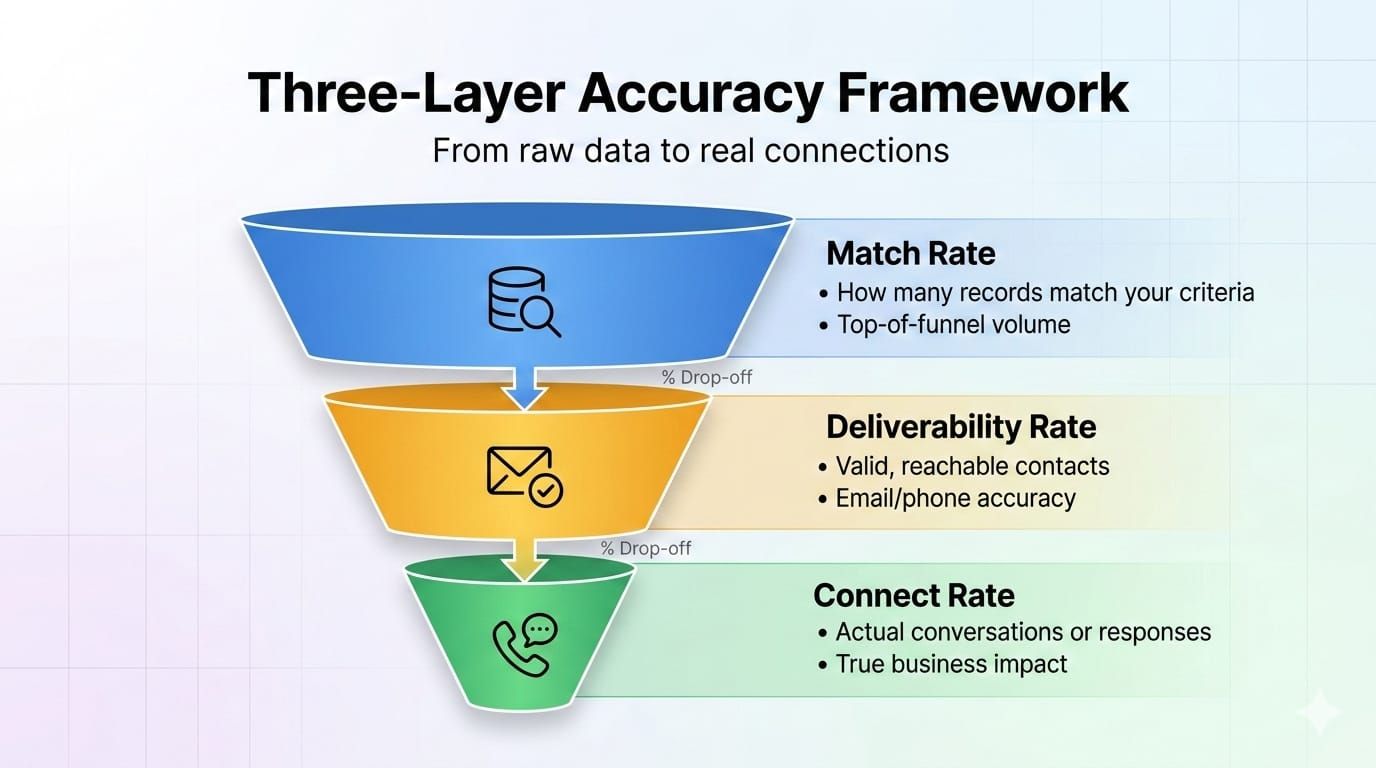
Vendor-reported "accuracy" often hides which layer they actually measure. Structure your evaluation into three distinct layers:
- Match rate: Did the platform return a record for the requested person?
- Deliverability rate: Did the email actually land in the inbox without bouncing?
- Connect rate: Did the phone number reach the intended buyer?
Benchmarks show massive variances across platforms, making it vital to measure real outcomes rather than returned records.
Check compliance and sourcing before you buy
Make compliance operational, not just legalese. Use this buyer checklist to protect your sender reputation and legal standing:
- Where does the data originate?
- Do they honor Global Privacy Control (GPC) and opt-out signals?
- Are they exposed as a data broker under new state laws?
- What is their GDPR posture?
- Can they explain source provenance clearly?
California, Colorado, and the CPPA increasingly enforce GPC and opt-out context, making compliance a direct financial imperative.
Run a 100-contact bake-off
Take 100 highly targeted, known accounts from your CRM. Test two to four providers simultaneously using the exact same ICP, region, and job titles. Measure match rate, verified email rate, and bounce rate. Reject any tool that looks incredible in a demo but fails on your specific ICP.
The Verification Paradox: Why B2B Data Decays
- Data dies quickly: Employment data is highly volatile, causing constant database erosion.
- Coverage is fragmented: No single vendor dominates every geography and vertical.
- Stacks beat single tools: Relying on one vendor guarantees blind spots in your pipeline.
Contact data goes stale continuously due to job transitions, title promotions, and company reorganizations. Domain changes, phone reassignments, and privacy opt-outs accelerate this decay. Real B2B contact data decay can start around 22.5% and climb as high as 70.3% annually depending on the specific segment and role.
Buyers fall victim to the Verification Paradox: bigger databases create massive freshness problems. Verification capacity cannot scale cleanly with record count. Processing 200 million records at one second per record takes roughly 6.34 years of continuous verification. A database claiming 300 million contacts guarantees that a massive percentage of those records are permanently stale. Modern revenue engines solve this by layering specialized tools rather than relying on a single mega-vendor.
B2B Contact Databases vs. Enrichment vs. Intent vs. Dynamic Pipelines
- Databases: Provide net-new leads based on ICP filters.
- Enrichment: Fixes and routes existing incomplete CRM data.
- Intent: Highlights who is currently researching your category.
- Dynamic Pipelines: Extract fresh web data continuously.
To build an optimized stack, you must understand the exact function of each tool category:
- Contact database providers handle net-new prospect and company discovery (e.g., ZoomInfo, Apollo.io, Cognism).
- B2B data enrichment tools append firmographic and technographic data to existing CRM records to maintain hygiene and enable automated routing (e.g., HubSpot Breeze Intelligence).
- Intent data platforms prioritize target accounts showing active market signals; they do not replace raw contact discovery (e.g., Demandbase).
- Dynamic data infrastructure pulls live web data continuously instead of relying on stored, stale records (e.g., Olostep).
Intent Data Reality Check
- Hygiene precedes intent: Do not buy intent signals if your CRM data is a mess.
- First-party beats third-party: Your own website data is vastly superior to syndicated topic spikes.
- Avoid the noise: Most intent signals fail to convert without strict scoring logic.
Intent data delivers ROI when you possess strong first-party data and fast routing to sales. It works best paired with clear account scoring logic and a pristine underlying data hygiene system.
However, intent data fails when teams drown in third-party noise and vague topic spikes. According to a recent survey of 750 senior marketing leaders, 87% of organizations admit to chasing unreliable or inflated intent signals, and only 26% of signals convert to qualified opportunities. First-party intent (who visits your pricing page) is significantly stronger, faster, and more actionable than external third-party signals.
When Static Databases Stop Working
- Static data has a ceiling: Reps waste hours patching holes in legacy databases.
- Niches require live extraction: Traditional vendors ignore hyper-specific industries.
- Pipelines beat lists: Building repeatable web extractions scales infinitely.
Traditional B2B data providers eventually hit a ceiling characterized by stale records and massive niche coverage gaps. Manual patching becomes necessary, costs rise exponentially as volume grows, and operators must buy multiple tools just to fill the holes.
This is where the operational question changes from "Which database should I buy?" to "How do I keep my data fresh continuously?"
Olostep provides a way to scrape and structure live web data, turning public sites into repeatable enrichment inputs. It empowers teams to build recurring research and refresh workflows directly via API. Relevant capabilities include real-time scrapes, scheduled agents, webhooks, and no-code automation via Zapier. Use Olostep to refresh company and team-page data immediately before outbound execution, build niche ICP enrichment jobs, and structure web data into JSON for CRM workflows.
Modern revenue teams are moving away from buying lists to generating proprietary data streams. By building dynamic enrichment workflows, these teams secure infinitely fresher data and eliminate the dependency on stale third-party providers.
Best B2B Data Stack by GTM Motion
Key Takeaways:
- Enterprise requires governance: Strict compliance and Salesforce depth win out.
- SMBs need speed: Low friction and fast sequencing drive early pipeline.
- Data teams need structure: JSON outputs and API reliability matter more than UI.
- Enterprise Outbound and ABM: Layer a primary database with account intelligence, a dedicated enrichment layer, and a dynamic refresh tool for coverage gaps. Focus strictly on governance, admin controls, strict compliance, and Salesforce depth.
- SMB Sales Teams: Pair a low-cost database with a lightweight verification tool. Prioritize fast setup, low friction, and quick time to pipeline.
- RevOps and CRM Enrichment: Use an enrichment-first approach to handle routing, deduplication, and scoring. Add a dynamic refresh layer specifically for updating stale fields and patching niche gaps.
- Agencies and Lead Generation: Combine flexible spend with fast verification and dynamic extraction for client-specific niches. Focus on scale, margin protection, and multi-client operational flexibility.
- Data and Analytics Teams: Prioritize exportability, structured fields, refresh cadences, and auditability. The goal is accurate data modeling and seamless data warehouse fit.
FAQ
What is a B2B data provider?
A B2B data provider is a platform that supplies revenue teams with contact details, firmographics, and intent signals. They allow sales, marketing, and RevOps to build lists, enrich CRM records, and execute outbound campaigns using targeted lead data.
Which B2B data provider is best?
The best provider depends on your specific use case. ZoomInfo leads for US enterprise, Cognism wins for European compliance, and Apollo.io dominates SMB outbound. For real-time data extraction and dynamic enrichment workflows, Olostep operates as the superior infrastructure choice.
Is ZoomInfo worth it?
ZoomInfo is worth it for large enterprise teams that need deep US coverage, organizational charts, and advanced Salesforce integration. It is rarely worth the premium price and strict annual contracts for lean startups running simple outbound motions.
What is the best alternative to ZoomInfo?
Apollo.io is the best alternative for SMBs needing integrated database and sequencing features. Cognism is the best alternative for EMEA teams requiring strict GDPR compliance. Olostep is the best alternative for teams wanting to extract live web data dynamically rather than buying static lists.
How accurate are B2B data providers?
Vendor claims of 95% accuracy are often misleading. Controlled benchmarks on phone-data accuracy show ranges from 63% to 91% depending on the provider; real connect rates vary further by provider, region, ICP, and calling motion. Accuracy must always be measured by real deliverability and connect rates, not just raw database match rates.
What are the best B2B data providers for lead generation?
For high-volume lead generation, Apollo.io offers excellent built-in sequencing, while UpLead and Lead411 provide affordable list building. Agencies managing niche client campaigns increasingly rely on Olostep to build live, custom data pipelines instead of static lists.
Final Recommendation: Choose the System, Not Just the Vendor
If you need one tool today, buy the platform that fits your immediate budget and workflow friction—usually Apollo for SMBs or ZoomInfo for the enterprise. If you require a layered stack, separate your discovery, enrichment, and verification budgets to maximize efficiency.
However, if you need continuous live data to bypass the Verification Paradox completely, transition to an API-driven extraction infrastructure. The best B2B data providers will give you a list, but building dynamic pipelines ensures that list never decays.
There is no perfect single vendor. Different tools solve different parts of the GTM data problem. The right choice depends entirely on your motion, maturity, and refresh requirements.