


The primary user of the web for work is switching from humans to AI agents.
Olostep (www.olostep.com) is an API for AI agents to search, extract, and structure Web Data.
Olostep is an abstraction layer over the internet.
The Web is the backbone of most businesses, both AI-native applications and more traditional companies.
In the next 2-5 years, the primary user of the Web for work will switch from humans to AI agents. All businesses will deploy AI systems, and these systems will need to search, extract, and structure knowledge from the Web. The web is the OS of work and contains humanity's collective knowledge. Without access to this living corpus, AI systems can only experience the past.
We are at the dawn of a new era and the market opportunity compounds with every advancement in model capabilities. What started as essential tooling for AI-native applications is quickly becoming critical for traditional enterprises deploying agent-based workflows, from recruiting healthcare professionals to the insurance industry. This is a multi-trillion-dollar market in formation.
Discipline in a massive market
Since the market is so big, it's easy to get lost in it and the company that will win it needs to be extremely disciplined.
Rather than trying to serve every use case at once, we're going deep into specific niche high-value verticals first, starting with AI visibility. We're building best-in-class products with specialized parsers, web indexes, small language models and domain expertise in a specific niche before expanding to other verticals.
This creates real differentiation and an incredibly sticky product with genuine domain knowledge and technical sophistication.
While competitors chase opposite extremes—some moving upstream to capture enterprises with high CAC and low switching costs, others targeting developers who provide diffuse feedback and resist payment—we've chosen the disciplined middle path, targeting the underserved market of small/medium startups.
Our customers are seed to Series B startups: companies with real business needs, a willingness to pay, and that provide focused product feedback. These are businesses on the path to scale, and as they grow, usage and revenue compound naturally. The customer base itself appreciates in value.
This is strategic. Your users pull your product in a particular direction. Choose wrong, and you optimize for the wrong problems. Our customers are building the AI-native companies that will define the next decade of software.
Current customers include YC and Sequoia-backed companies and we've handled hundreds of millions of requests.
The team and our conviction
Our team has the technical backgrounds, sense of craftsmanship, creativity, and rigor needed to create a great product and an outstanding company around that product.
Arslan (CS@Stanford, fmr lead engineer at 2 YC startups) worked on this problem in the early days at Legora, the Swedish legal-tech company now valued at $1.8B, and then together with Hamza at Zecento, one of the most popular e-commerce productivity products in Italy.
We're at an inflection point similar to the late 90s internet, but the scale is different. If the first web connected billions of people to information, the next connects trillions of agents to knowledge. Each agent needs to search, extract, and structure data at volumes humans never could.
We're building the layer that makes the web accessible to AI systems to automate the real-world economy. Our conviction is straightforward: agents need access to real-time web data to be useful, and that access needs to be reliable, structured, built for how models actually work, and contextualized for each vertical.
What's Next
A follow-up question to the industry in which Olostep is operating (that can be broadly categorized as search for AI) is: What will be the interface for this? For humans, browsers have become synonymous with search and web access. We use the browser both to search and extract data from the Web but also to work and act on it (e.g. apply for jobs, submit forms, buy things online). Will the same apply to AIs?
Will AIs use APIs or a browser? or both?
As we transition from a Web that simply answers our questions to an agentic Web that anticipates our needs, entirely new possibilities and scenarios emerge.
We believe search and data extraction for AI will be an API first approach, like the one we have been focusing on at Olostep with our unique architecture and insights.
Instead, for working and acting on the web, the browser for AI agents will look different from current solutions, especially for business applications. Today's options—headless browsers in the cloud and consumer browsers like Comet or Atlas—miss key requirements.
Thinking from first principles, for AI to do work on our behalf, especially in a business context, it needs to:
- Operate where the user is: On the edge to leverage hardware advancements (e.g. M5 chip), guarantee privacy and reliability, be cost effective, have low latency and provide access to user cookies and context (something headless browsers in the cloud cannot provide)
- Preserve user freedom: By working within users' existing browsers rather than forcing them to switch environments or lock into single-vendor ecosystems (the approach taken by Comet or Atlas, which can work for consumers but not businesses)
- Be extensible: Every business has unique edge cases to handle. They need foundational building blocks that they can customize for their specific requirements—not rigid, one-size-fits-all solutions
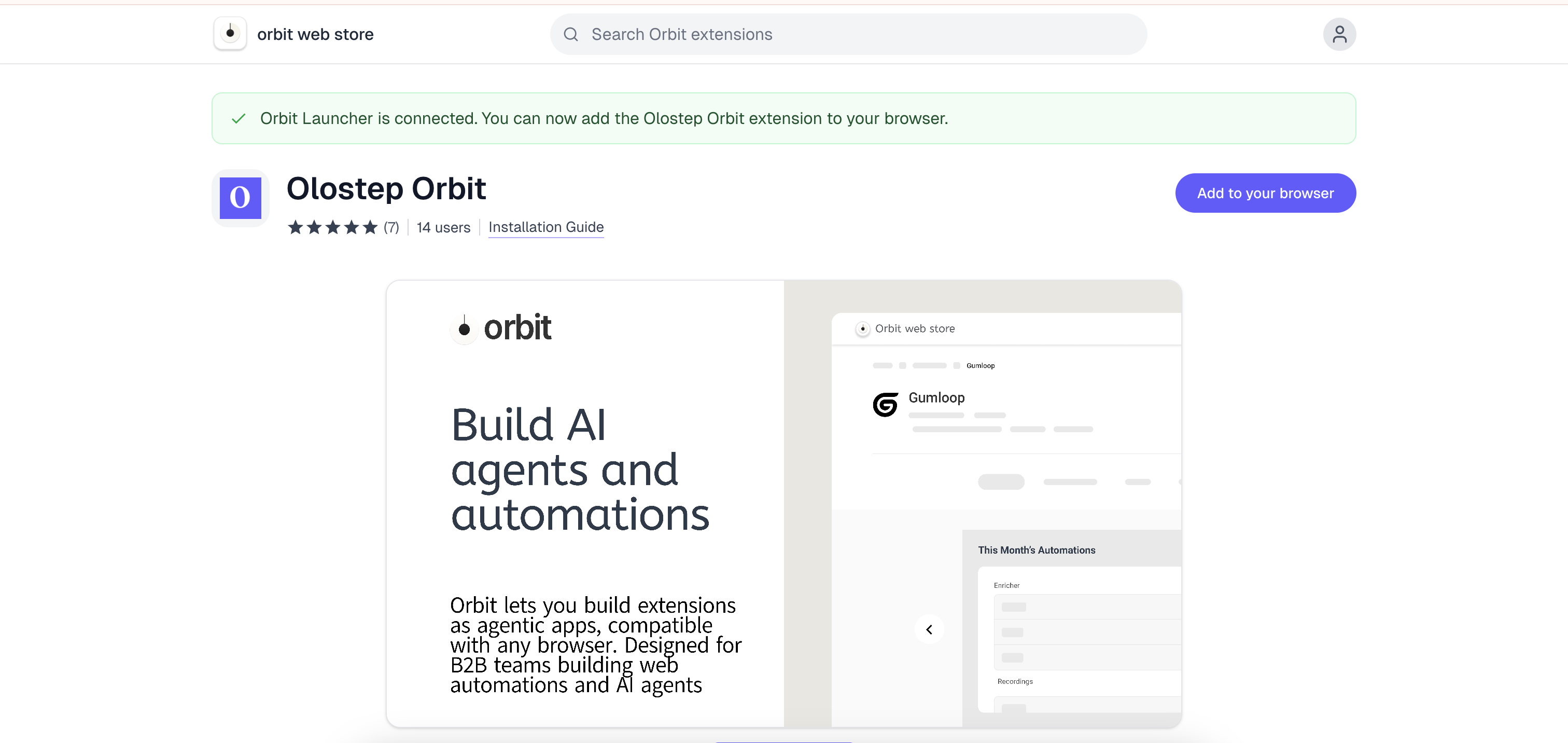
We have been working closely with startups and companies on this, and it's clear that Olostep Orbit is the right solution. We are going to launch it in 2026.
Our goal for the next decade is to build the web operating system for global business:
Infrastructure → Software → AI Agents → Web OS for Business